sábado, 31 de marzo de 2007

Plaza Dorrego

Plaza Dorrego (Spanish: Dorrego Square) is a square located in the heart of San Telmo, in Buenos Aires, Argentina. In the 19th century, San Telmo was the main residential barrio (neighbourhood) of the city and Plaza Dorrego was its focal point.

In the past it was referred to as Hueco del Alto or Alto de la carretas as it was the place where wagons would stop before crossing the Tercero del Sur stream (today called Pasaje San Lorenzo) on their way downtown. The name had been Alto de San Pedro and later changed to Plaza del Comercio in 1822. In 1905, the name was changed once again to its current form.

The buildings located in the square maintain its original design thanks to the help of the Comisión del Museo de la Ciudad.

Currently, its surroundings are full of coffee shops, bars and pubs, which fill the square with tables from those shops. There are also several antique stores. Musicians and dancers particularly tango exhibitions are seen. The Feria de San Telmo (San Telmo Fair), mainly of antiques, runs every Sunday.

Plaza Dorrego is located at the intersection of Humberto I and Defensa streets. Along with La Boca, Recoleta, Florida, and others, Plaza Dorrego is one of the main tourist attractions of Buenos Aires.

Source

Catedral Metropolitana de Buenos Aires

The Buenos Aires Metropolitan Cathedral (Spanish: Catedral Metropolitana de Buenos Aires) is the main Catholic church building of Buenos Aires city, Argentina. It is located at the corner of San Martín and Rivadavia streets, in the San Nicolás neighbourhood, in front of the Plaza de Mayo at the city's downtown.

The building's style is neoclassical, with a prominent dome but not a traditional steeple.

The current building was designed by Turinesse architect Antonio Masella. Its construction began in 1753, and was finished over a century later. Even though the cathedral was consecrated in 1791, construction of its facade only began as late as 1802, during the government of Bernardino Rivadavia, from a design by French architects Catelin and Benoit. Construction was temporarily halted in 1827. It then resumed, and continued slowly to completion.

The body of General José de San Martín is entombed in a separate mausoleum reachable from the main body of the cathedral. He was believed to be a Freemason, and was therefore not buried in the cathedral proper.

Five previous churches occupied the same ground before the current building. The first one was made of mud but it was destroyed in 1593; the second was inaugurated in 1608, but fell down in 1616; the third was constructed with wood brought from Paraguay but did not last long; in 1680 the roof of the fourth church inaugurated in 1671 fell down, forcing its total demolition; the fifth was designed by architect Bianchi, but by 1752 it had already begun to fall apart.

Source

Teatro Colón

The Teatro Colón (Spanish) (Colón Theatre) in Buenos Aires, Argentina is one of the most famous opera houses in the world. The present theatre, the second with that name, opened in 1908 after twenty years under construction. It has 2,367 seats and standing room for 1,000.

It is located on 9 de Julio Avenue, in the heart of the city, although the main entrance is on Libertad street.

Prior to the construction of the current Teatro Colón, opera performances were given in several theatres, of which the first Teatro Colón (see below) and the Teatro de la Ópera were most important. The principal company that performed at the Teatro de la Ópera moved to the Teatro Colón in 1908. However, important companies also performed at the Teatro Politeama and the Teatro Coliseo which opened in 1907. In many seasons, the Teatro Colón was the first stop on an extended tour of South America which would also include visits to Montevideo, Rio de Janeiro, São Paulo and sometimes other cities.

The first Teatro Colón

By the mid-1850s, with the flourishing of opera given by touring companies, the need for a new theatre became obvious. In 1854 alone, 53 different operas were performed in the city. The first “Teatro Colón” was built in 1856 and opened on 25 April 1857 with Verdi’s La Traviata, just four years after its Italian premiere. It proved to be a reliable venue for over 30 years, with 2,500 seats and the inclusion of a cazuela , a separate gallery, which was reserved only for women. By the 1880s, the need for a modern facility became apparent and the building was sold to a bank, the proceeds from which would support the construction of a new opera house in a central location.
The present Teatro Colón

The cornerstone of the present Teatro Colón was laid in 1889 under the direction of architect Francesco Tamburini and his pupil, Angelo Ferrari, who designed a modern theatre in the Italian style on a scale and with amenities which matched those in Europe. However, due to local arguments regarding location and other factors, construction dragged on for twenty years before the house was completed by Julio Dormal in 1908. In the intervening years, Tamburini died and Ferrari was assassinated, thus complicating the process.

The theatre opened on 25 May 1908 with a performance of Verdi’s Aida and it quickly became a world-famous operatic centre rivaling La Scala and the Metropolitan Opera in attracting major talent. Over the years, the Colón Theatre has hosted such great names as Titta Ruffo, Amelita Galli-Curci, Giacomo Lauri-Volpi, Arturo Toscanini, Jane Bathori, Enrico Caruso, Claudia Muzio, Viorica Ursuleac, Maria Callas, Jon Vickers, Norman Treigle, Beverly Sills, John O'Sullivan, Renata Tebaldi, Plácido Domingo, Ástor Piazzolla and Luciano Pavarotti.

With perfect acoustics and modern stage areas, the theatre's interior design featured a rich scarlet and gold decor. The cupola contains frescoes painted in 1966 by the renowned 20th century artist Raúl Soldi during renovation work.

In recent years, given the political and economic circumstances of Argentina, the Colón Theatre has suffered considerably but has begun a period of slow recovery.

The theatre is presently undergoing several phases of remodeling and production activities ceased at the end of October 2006 to allow full refurbishment to take place in time for its re-opening on 25 May 2008, the present theatre's 100th Anniversary.

Source

Plaza de Mayo

The Plaza de Mayo (Spanish for May Square) is the main square in downtown Buenos Aires, Argentina, at 34°36′30″S, 58°22′19″WCoordinates: 34°36′30″S, 58°22′19″W; it is flanked by Hipólito Yrigoyen, Balcarce, Rivadavia and Bolívar streets. Several of the city's major landmarks are located around the Plaza: the Cabildo (the city council during the colonial era), the Casa Rosada (home of the executive branch of the federal government), the Metropolitan Cathedral of Buenos Aires, the current city hall or municipalidad, and the headquarters of the Nación Bank. The Buenos Aires financial district (microcentro), affectionately known as la City (sic) also lies besides the Plaza.

Political significance

The Plaza de Mayo has always been the focal point of political life in Buenos Aires. Its current name commemorates the May Revolution of 1810, which started the process towards the country's independence from Spain in 1816.

On October 17, 1945, mass demonstrations in the Plaza de Mayo organized by Evita and the CGT trade union federation forced the release from prison of Juan Domingo Perón, who would later become president of Argentina. For several years the Peronist movement gathered every October 17th in the Plaza de Mayo to show their support for their leader (and October 17 is still "Loyalty Day" for the traditional Peronists). Many other presidents, both democratic and military, have also saluted people in the Plaza from the balcony of the Casa Rosada.

In 1955 the Plaza de Mayo was bombed by planes of a military faction trying to overthrow Perón, killing over 300 bystanders and wounding many more. Although the coup was aborted, three months later, the Revolución Libertadora ("Liberating Revolution") succeeded and staged its own demonstration in the same Plaza that used to be a symbol of Peronism.

Years later, in 1974, Perón, then president for the third time, expelled from the Plaza the members of the Montoneros, an armed organisation that tried to influence the political orientation of the national government.

Crowds gathered once again on April 2, 1982 to hail de facto President Leopoldo Galtieri for starting the Falklands/Malvinas war.

Since the late 1970s, this is where the Mothers of the Plaza de Mayo have congregated with signs and pictures of desaparecidos, their children, who were subject to forced disappearance by the Argentine military in the Dirty War, during the National Reorganization Process. The Argentine military was anti-Communist, and people perceived to be supportive of such ideas would be illegally detained, subject to abuse and torture, and finally murdered in secret. The Mothers of the Plaza de Mayo took advantage of the symbolic importance of the Plaza to open the public's eyes to what the military were doing.

Protests have continued on taking place, with the major last one being during the December 2001 riots when five protesters were shot to their deaths and several others injured by police as they rioted around Plaza de Mayo.

Today, Plaza de Mayo continues to be a tourist attraction for those that visit Buenos Aires.

Source

Casa Rosada

La Casa Rosada (Spanish for "the Pink House"), officially known as the Casa de Gobierno ("Government House"), is the official seat of the executive branch of the government of Argentina. (When not working at the Casa Rosada, the president resides in a compound in Olivos, Buenos Aires.)

The Casa Rosada was built in the location which, since the foundation of the city of Buenos Aires, the top political institutions of Argentina resided. The current Italian-style building, however, dates back only to 1873. Constructed in the late 19th century over the foundations of an earlier Customs House, Post Office, and fortress, it stands at the eastern end of the Plaza de Mayo. Its balcony, which faces this large square, has served as a podium by many figures, including Eva Perón, who rallied the descamisados there, and Pope John Paul II, who visited Buenos Aires in 1998. Madonna sang her filmed rendition of the song "Don't Cry for Me, Argentina," for the movie Evita, from the balcony after a meeting with then President Carlos Menem.

The building is painted a light pink colour (and a darker pink colour on the side facing the plaza, after a recent repainting). It is currently going through an extensive renovation, including repainting. Dubbed "Casa Rosada" by President Domingo Faustino Sarmiento, it is said that he chose this colour scheme in order to defuse political tension by fusing the red and white colours of the country's opposing political parties. An alternative explanation points to the fact that the original paint used contained cow blood to prevent damage from humidity.

Source

Puerto Madero

Very touristic. Many bars and restaurants.

Puerto Madero is a neighborhood, or barrio, of the Argentine capital, Buenos Aires, which occupies a significant portion of the Río de la Plata riverbank.

History

In the 1930s, port facilities were relocated to the Puerto Nuevo ("new port"), 1 km to the north, and most of the older brick warehouses were all but abandoned. In the 1990s, local and foreign capitals invested in a massive gentrification effort, recycling the west side warehouses into lofts and restaurants, and adding some new hotels and office buildings, mostly in the east side. A new marina was built in the northernmost dock. In the 2000s the process continued, and more hotels, office and appartment buildings, both low rise and high rise have been built. Currently more buildings are under construction in the east side, including an office tower by Cesar Pelli and a mixed uses complex by Foster, the latter part of Faena's Porteño Art District. Recently, development has started in the last undeveloped part of the neighborhood, the east side of Dock 1, where infrastructure is been set and the first buildings are rising. According to current plans Dock 1 will not have high rises because of height limitations of about 20 storeys.

Transportation

The neighborhood's road network has been entirely rebuilt, especially in the east side. The layout of the east side consists currently on three wide boulevards running east-west crossed by east side's main street, Juana Manso Avenue. The layout is completed with some other avenues and minor streets, running both east-west and north-south, and by several pedestrian malls.

An expressway connecting the north and the south of the city trough Puerto Madero has long been in the planned stages. Several alternatives have been considered, including elevated, at-grade and underground, and even an underwater proposal by private developer Julio Torcello, which would had run under the four docks (this last proposal was dismissed as impossible to build. All proposals have received criticism: the elevated and at-grade options because they would mean a barrier between Puerto Madero and the rest of the city, and the underground because of the costs and the negative impacts during construction. Placing the expressway outside the city, between Puerto Madero and the Costanera Sur Natural Preserve has also been considered, but has received strong opposition from environmentalists. All the streets of Puerto Madero are named after women. The Puente de la Mujer (Women's Bridge), by architect Santiago Calatrava, is the newest link between east and west sides of Puerto Madero.

Currently a light rail line is being built alongside the west side's main street, Alicia Moreau de Justo Avenue, the Tranvía del Este, wich is planned to open later this year. But even after this effort is completed, the neighborhood will not be well connected to the city's transit network. Few bus lines run trough the neighborhood, and no subway line reaches it. Currently there are no official plans to extend the subway network to the neighborhood.

Source


Plaza Miserere

I call it misery square :D On a side street very close to it is the disco (República Cromañón) that burned so badly on December 30 2004 with so many casualties. I can still hear the ambulances going on and off even in our neighborhood.

The Plaza de Miserere is one of the main plazas of Buenos Aires, Argentina. It is located in the heart of the Balvanera neighborhood. It was supposed to be the name of the Line A—Buenos Aires Metro station located below it, but the station is more popularly known as Plaza Once, and is located alongside the station Once de y Septiembre of the Ferrocarril Sarmiento (Sarmiento railroad).

The plaza lies on a site where forerly lay a mansion known as the Quinta de Miserere. Around 1814, it was known as Mataderos de Miserere (slaughterhouse of Miserere), Hueco de los corrales (Hole of the corrals) in 1817, and Mercado del Oeste (Western Market) by 1850. It was also known as Mercado (or Plaza) 11 de septiembre (Market or plaza 11th of September). The name Plaza Miserere dates from 1947.

The plaza was the site of skirmishes during the British invasions of 1806. It was the site of the defeat of the troops under Santiago de Liniers during the second invasions of 1807.

The market functioned until 1882, when Torcuato de Alvear (father of president Torcuato de Alvear) began the demarkation of the plaza. In 1913, it underwent an important remodeling when the subway station was built beneath it.

The current design is from 1923, the mausoleum of Bernardino Rivadavia was added in 1932, where his ashes remain despite his wish that the not stay in Argentina.

Source


Puente de la Mujer

And seems Chicago Spire is also a project from Calatrava says Wikipedia? On the background btw is the Dutch Embassy and the Hilton Hotel (where they are building a second tower)

"The Puente de la Mujer (Spanish for "Women's Bridge") is a footbridge in the Puerto Madero barrio of Buenos Aires, Argentina that spans "dique 3" (dock 3). It is of the Cantilever spar cable-stayed bridge type and is also a swing bridge, but somewhat unique in is asymmetrical arrangement. It has a single mast with cables suspending a portion of the bridge which rotates 90 degrees in order to allow water traffic to pass. When it swings to allow watercraft passage the far end comes to a resting point on a stabilizing pylon.

It was designed by Santiago Calatrava and is similar to his Puente del Alamillo and Sundial Bridge at Turtle Bay, but with a forward, rather than a reverse angled cantilever, as is seen in those bridges. The footbridge was donated by Don Alberto L. Gonzalez to the City of Buenos Aires in thanks for 60 years of work in the country. Started in 1998, it was completed on 20 December 2001."

Source

La Recoleta Cemetery

La Recoleta Cemetery is a famous cemetery located in the exclusive Recoleta neighbourhood of Buenos Aires, Argentina.

The Cemetery includes graves of some of the most influential and important persons of Argentina, including several presidents, scientists, and wealthy characters. Internationally, Eva Perón is one of the best known persons buried in this cemetery.

The entrance to the cemetery is through neo-classical gates with tall Greek columns. The cemetery contains many elaborate marble mausoleums, decorated with statues, in a wide variety of architectural styles. The entire cemetery is laid out in sections like city blocks, with wide tree-lined main walkways branching into sidewalks filled with mausoleums.

While many of the mausoleums are in fine shape and well-maintained, others have fallen into disrepair. Several can be found with broken glass, littered with rubbish, and on occasion you might find a mausoleum being used as a janitorial supply closet, with cleaning and maintenance products stored on top of coffins.

Each mausoleum bears the family name etched into the facade; brass or bronze plaques are added to the front for particular family members. La Recoleta is one of those cemeteries where the tradition of engraving a death date but no birth date has been maintained.

One interesting and unique aspect of La Recoleta is a colony of feral cats that resides within the gates. Although they can be spotted anytime, they tend to gather in groups of dozens near closing-time, when some locals feed them.

The cemetery was featured in the educational film Destinos as the final resting spot of a wife of the main character.

Famous People buried at La Recoleta
Some of the famous interred in La Recoleta Cemetery are:

* Juan Bautista Alberdi (1810-1884), writer, politician, lawyer
* Juan Pujol, the first Governor of the Province of Corrientes and designer of the First Argentine National Stamp.
* Luis César Amadori (1902-1977), poet, composer
* Nicolás Avellaneda (1837-1885), President of Argentina
* Susan Barrantes, (1937-1998), mother of Sarah Ferguson, Duchess of York
* Adolfo Bioy Casares (1914-1999), writer
* Miguel Juárez Celman (1844-1909), President of Argentina
* Juan Manuel Fangio (1911-1995), F1 champion race car driver
* Juan Manuel de Rosas (1793-1877), politician, caudillo
* Luis Firpo (1894-1960), heavyweight boxer, "The Wild Bull of the Pampas"
* Oliverio Girondo (1891-1967), poet, journalist
* José Hernandez (1834-1886), writer
* Arturo Umberto Illia (1900-1983), President of Argentina
* Enrique Larreta (1875-1961), writer
* Luis F. Leloir (1906-1987), scientist, Nobel Prize winner in Chemistry
* Leandro Alem (1844-1896) politician
* Cándido López (1840-1902), painter and soldier
* Vicente López y Planes (1785-1856), lyrcist, politician
* Leopoldo Lugones (1874-1938), writer
* Eduardo Mallea (1903-1982), novelist, essayist
* Carlos Menditeguy (1915-1973), race car driver and sportsman
* Bartolomé Mitre (1821-1906), writer, former president
* Victoria Ocampo (1890-1979), writer, publisher
* Carlos Pellegrini (1846-1906), former president
* Luis Piedrabuena (1833-1883), explorer
* Eva Perón (1919-1952), First Lady of Argentina
* Honorio Pueyrredón (1876-1945), educator, statesman
* Juan Manuel de Rosas (1793-1877), politician
* Hipólito Yrigoyen (1852-1933), politician, former president
* Dante Quinterno (1909-2003), cartoonist
* Carlos Saavedra Lamas (1878-1959), statesman, Nobel Peace Prize winner
* Domingo Sarmiento (1811-1888), writer, former president
* Juan Facundo Quiroga (1790-1835), caudillo (subject of the book Facundo; Sarmiento's most famous work; his remains were only recently discovered in the cemetery)

Source

Avenida Corrientes

Corrientes Avenue (Avenida Corrientes in Spanish) is one of the principal thoroughfares of the Argentine capital of Buenos Aires. The street is intimately tied to the tango and the porteño sense of identity. Like the parallel avenues Santa Fe, Córdoba, and San Juan, it takes its name from one of the Provinces of Argentina.

It extends 69 blocks from Eduardo Madero Avenue in the eastern Puerto Madero neighborhood to the West and later to the Northwest, and ends at Federico Lacroze Avenue in the Chacarita neighborhood. Automobile traffic runs from west to east. Línea B of the Buenos Aires Metro runs most of underneath the street.

The Asociación Amigos de la Calle Corrientes ("Friends of Corrientes Street Association") is a group that collaborates on the urban planning of the street. They have placed commemorative plaques on 40 street corners bearing the distinguished figures from the history of the tango.

History

It was named del Sol during the 17th century, San Nicolás from 1738 to 1808, and de Incháurregui from 1808 until 1822, when it received its current name. In 1938 the street was widened and turned into an avenue. When referring to Corrientes prior to the widening, the term "Narrow Corrientes" (Corrientes Angosta) is used.

Points of interest

Base to obelisk

* Luna Park, former boxing ring, currently used for other sports
* The back of the Central Post Office
* The downtown microcentro banking district
* Florida pedestrian street
* Some theaters.
* Several restorants, including Argentine barbeque, Argentine cuisine, Spanish cuisine and Italian cuisine.
* The Obelisk of Buenos Aires, at the intersection with 9 de Julio Avenue.
"The street that never sleeps"

* Los Inmortales pizzeria, previously the Café de los inmortales, ("Café of the immortals") with photos of the historic figures that visited it.
* Güerrín pizzeria
* Café La Paz, historic meeting place for leftist activists
* Bar Ramos
* La Giralda Cafeteria, serving hot chocolate and churros
* General San Martín Theater
* La Plaza complex, a private enterprise with theaters and restaurants
* Hernández, Liberarte, and many other bookstores

Off-Corrientes

"Off-Corrientes" refers to the alternative playhouse area. It is also home to the Ricardo Rojas Center of the University of Buenos Aires, which is promotes experimental art (but is itself located on Corrientes).

Once

The Balvanera barrio (also known as Once) is a traditionally Jewish neighborhood known for the wholesale and retail sale of clothing, now also home to merchants of other nationalities, including Koreans.

Abasto

Beyond Pueyrredón Avenue is the hometown of Carlos Gardel, the tango singer known as the "morocho ("dark-haired man") of Abasto". Now in disrepair, the neighborhood is slowly making a comeback. The neighborhood's name is derived from the Mercado de Abasto, a former fruit and vegetable market that is today the city's largest shopping center.

Almagro

Almagro is a calm residential neighborhood inhabited by apartment-dwellers. The center of activity is at the intersection of Medrano and Rivadavia Avenues.

Villa Crespo

Villa Crespo is another traditionally Jewish neighborhood. Unleavened bread is available for passover, as are other seasonal specialties. It is in this area (formerly called "Triumvirate") that the greater part of the 1948 Leopoldo Marechal novel Adán Buenosayres takes place. The neighbourhood is also home to the Atlanta football club.

The barrio was home to tango great Osvaldo Pugliese.

La Quinta del Ñato

Corrientes ends at the train station next to the Cemetery of La Chacarita, and then runs alongside the Parque Los Andes, where pleasure fairs where held until September of 2005.

(La Quinta del Ñato is a lunfardo way of referring to a person's last dwelling.)

Corrientes in tango music

Corrientes Avenue is featured in several tango lyrics, notably:

* A media luz by Carlos Lenzi and Edgardo Donatto
* Calle Corrientes by Alberto Vaccarezza and Enrique Delfino
* Corrientes angosta by Ángel "Pocho" Gatti
* Corrientes y Esmeralda by Celedonio Flores and F. Pracanico
* Tristezas de la calle Corrientes by Homero Esposito and Domingo Federico, 1942
* Pucherito de gallina

Source

3D Flyby

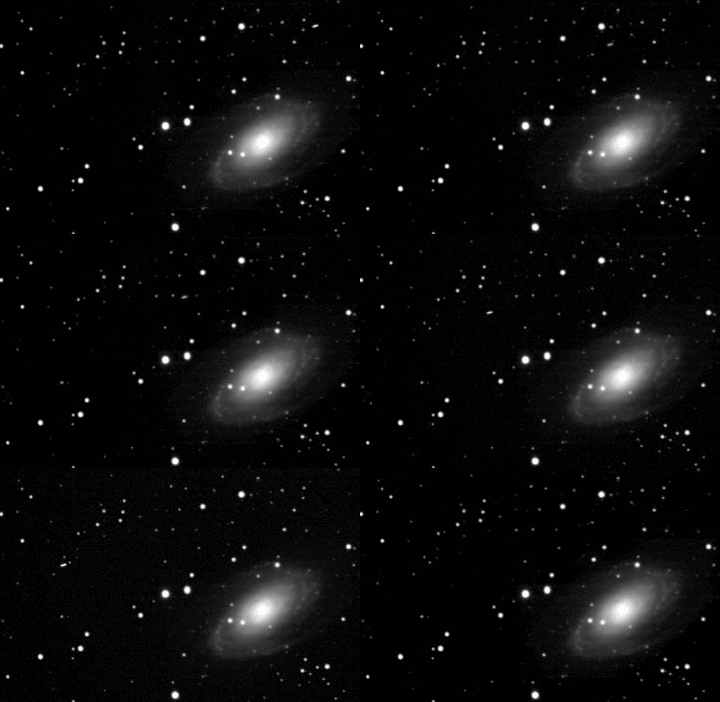
"Get ready to cross your eyes. On March 28th, when asteroid 2006 VV2 flew past spiral galaxy M81, two photographers on opposite sides of the USA photographed the encounter. A cross-eyed view of their photos makes the asteroid pop out in startling 3D:

(Hint: Stare at the middle of this image and cross your eyes until the two galaxies overlap. Focus on the asteroid. The longer you stare, the more pronounced the 3D sensation becomes.)

"I produced this stereogram by combining the images of William Keel in Tuscaloosa, AL, and Robert Long in Vado, NM," explains Colorado astronomer Chris Peterson. "Because the asteroid was so close (4.6 million km), and the baseline between the images so long (1780 km), the parallax between the asteroid and the background stars is significant, and the stereo effect is quite real." [more]

Another must-see image is Robert Long's motion picture of the asteroid-galaxy flyby. Click here to play the 1.6 MB movie."

Source

Pigs in Space meets Star Wars

Pigs in space: Skywalker, C-3PO, R2-D2 and Chewy with the muppets.


No pics today

The weather is not fine today so I'm not going to make those pictures today. To bad. Besides that there seems to be little updated news looking at my RSS feeds so weekends will probably have less posts than week days.

viernes, 30 de marzo de 2007

Argentina pushes diplomacy in new Falklands bid

Monday is Malvinas Day here so i'm not surprised. Will write about it then. Has an interesting side to it.

"Twenty-five years after hostilities ceased, Argentina is opening a new front in the Falklands War.

Rather than jets and mortar rounds, however, this salvo involves diplomats appealing for help at the United Nations and the government reasserting long-standing claims to the island chain, where far more sheep than people huddle against the forbidding South Atlantic winds.

London, however, maintains its hold on the island, which Argentina invaded 25 years ago this Monday.

Many Argentines -- especially the left-wing power base of President Nestor Kirchner -- see the war as a huge mistake pursued by the nation's discredited military dictators.

But Argentines still universally call the Falklands -- known in South America as the "Malvinas" -- as their own. And in this election year, Kirchner appears poised to gain support by pushing hard against Britain's firm refusal to negotiate on the islands' fate.

"Argentina has never consented to the United Kingdom's claim of rights to the territory," Eduardo Airaldi, Kirchner's top official in charge of the South Atlantic region, said as he described Kirchner's position in an interview with The Associated Press.

Kirchner's predecessors didn't do as much to press Argentina's claims to the islands. Former President Carlos Menem restored diplomatic ties with Britain in 1990 after agreeing to shelve the sovereignty question.

In contrast, Kirchner declared the archipelago's recovery to be "a permanent and irrevocable objective of the Argentine people." His government expressed irritation when Britain protested the presence of an Argentine ship near the islands and challenged changes to fishing rights made by Falklands administrators.

In January, he sent his foreign minister to lobby U.N. Secretary-General Ban Ki-moon to support new sovereignty talks.

Argentina on Tuesday said it scrapped a deal Menem had signed with the British to explore for oil and natural gas around the Falklands. The joint venture yielded no major discoveries, but was long on symbolism, since it represented an Argentine acknowledgment of British rights to the sea floor. Britain's Foreign Office called the end of the deal a "regrettable action" that "will not in any way help Argentina in its claim for sovereignty of the Islands."

Just before the Argentine invasion on April 2, 1982, diplomats from both countries had been talking about an eventual Hong Kong-like handover of the colony Britain had occupied since 1833, despite the idea's unpopularity in London and among the 3,000 or so British-descended residents of the island, known as "kelpers."

But the invasion changed all that.

"We will not discuss sovereignty unless and until the Islanders so wish. At present they do not," a British Foreign Office spokeswoman told the AP on condition of anonymity in line with department policy. "In this respect, 1982 changed everything."

Britain reacted quickly to the invasion, summoning the Queen Elizabeth 2 cruise ship to carry 3,000 troops and mobilizing an armada that included Prince Andrew to sail some 8,000 miles south.

British artillery pounded the Argentine draftees who had dug foxholes in the rocky soil. Humbled by the onslaught, the South American nation surrendered that June 14, after 649 Argentine and 272 British troops were killed.

The two countries share a long history -- the British helped build Argentina's railroads and promoted its beef industry. A large British community still lives in Argentina, served by an English-language daily paper in the capital.

But the Falklands dispute remains an open wound. Many public schools, streets, small businesses and taxi stands are proudly named for the Malvinas. Billboards that read "The Malvinas are ours" are a common sight.

Kirchner has sought to avoid offending either the left or the right in Argentina by focusing on the idea that Britain acted illegally when it expelled an Argentine military garrison from the islands in 1833, a nationalist tone that analysts say won't hurt him this election year.

So Argentines were outraged recently when British Prime Minister Tony Blair compared the British retaking of the islands to the Kosovo air war that led to the overthrow of Serbian strongman Slobodan Milosevic.

"I have got no doubt it was the right thing to do," Blair said in a podcast on his Web site. "But for reasons not simply to do with British sovereignty but also because I think there was a principle at stake which is that a land shouldn't be annexed in that way."

Many Argentines initially supported the war as well, but came to blame the ruling military junta for picking a fight the country had little hope of winning, and sending conscripts to their deaths.

The greatest legacy of the 74-day war for Argentines is that the defeat hastened the fall of the dictatorship a year later in 1983, said Riordan Roett, a political scientist at Johns Hopkins University."

Source

The name Dauntless

I never told why i chose the name Dauntless on the blog. Well, I'm an airplane fan and i like WW II history. The Dauntless is a US airplane used in the Pacific war against Japan. And maybe the name fits me? Who knows! It's a daunting move to go live in another world.

A detailed description of the SBD Dauntless on my other blog.

Asteroid to Pass Near Earth Friday Night

"An asteroid will fly past Earth tonight (March 30) about 2 million miles away. That's about nine times farther away than the Moon.

There is no danger of collision. And that's a really good thing. This space rock, named 2006 VV2, is more than a mile wide (about 2 kilometers), according to the web site Spaceweather.com. If one that big did hit Earth, it'd destroy everything for hundreds of miles around and likely upset global commerce and create climate change unlike anything seen in modern history.

The rock will be far too dim to see with the naked eye. Seasoned backyard astronomers will try to spot it with good-sized telescopes and CCD cameras, however.

The best viewing locations will be in the Americas, according to Spaceweather.com. The rock will pass directly over southern California at about 11 p.m. local time.

Astronomers have catalogued hundreds of asteroids larger than a half-mile that sometimes pass in the vicinity of Earth's orbit. None are known to be on a collision course, but more remain to be found. One asteroid, called Apophis, will pass very close to Earth in the year 2029 and has a minor chance of hitting the planet in 2036. Some have called for a mission to track Apophis more closely by attaching a device to it."

Source

Say it with flowers

"The discovery in 2003 of the tomb of Djehuty, overseer of works at Thebes during Queen Hatshepsut's reign, amazed Egyptologists and historians not only because of its distinguished and uncommon architectural design and decorative scenes, but also for the artefacts found within its corridors -- objects from different dynasties piled in the tomb to form a haphazard treasury. These finds, made at Draa Abul-Nagaa on Luxor's west bank by a Spanish-Egyptian archaeological team, revealed more details about an unusual time in Egypt's ancient history.

This week after six consecutive concessions, the mission has unearthed instruments used at the funeral inside the tomb that add emphasis to the importance of Djehuty's position.

While cleaning the debris in the tomb's open courtyard archaeologists found a 70cm-deep pit containing 42 clay vases and 42 flower bouquets.

"These are probably the remains of Djehuty's funerary [bouquets] that were later thrown inside the tomb," Spanish mission director José Gal´n said..."

Source

View from the upper window

This is how we have it for days now.

Time travel

Weird story of a guy who claims to have visited his future self and even got it on the cam of his phone. ???

Astronaut Will Run Boston Marathon from Space

If you have nothing else to do up there :)

"Zooming through low-Earth orbit at 17,500 mph, Suni Williams completes the standard marathon distance every 5.4 seconds. Good thing Rosie Ruiz never thought of that.

Williams is registered for next month's Boston Marathon, even though she'll be stuck on the international space station when the rest of the field lines up for the 111th edition of the race. So the U.S. Navy commander will run the equivalent distance on a treadmill -- 210 miles above Earth, and tethered to her track by bungee cords so she doesn't float away.

Not since Ruiz hopped the 'T' to the finish line to accept the winner's wreath in 1980 has a Boston Marathon competitor relied so heavily on public transportation.

"She thought it would be cool if she gave it a try,'' said Williams' sister, Dina Pandya, who will run the race the traditional way. "She said, 'I'll call you on Heartbreak Hill.'''

Another NASA astronaut, Karen Nyberg, will dodge the potholes from Hopkinton to Boston's Back Bay on April 16 along with Pandya and almost 24,000 other runners. Although the race starts at 10 a.m. EDT on Earth, Williams might not be able to run contemporaneously because her sleep schedule -- a fairly arbitrary matter in space -- is set for the arrival of a Soyuz mission.

"I'm not sure the timing will be that she'll be awake,'' Pandya said. "They're going to be on Russian time, so they're kind of sleep-shifting.''

Williams qualified for the Boston race by finishing last January's Houston Marathon in 3 hours, 29 minutes, 57 seconds. Pandya didn't sweat the logistics when she signed them both up, but on Dec. 9 Williams took off on the space shuttle Discovery and it became clear she wasn't going to make it to the starting line.

"I considered it a huge honor to qualify, and I didn't want my qualification to expire without giving it a shot,'' Williams told the Boston Athletic Association, which organizes the oldest of the world's annual marathons.

The BAA offered to send an official entrant's bib and a special finisher's medal -- made without lead, per NASA orders -- to the space station. But when this month's launch of the shuttle Atlantis was postponed, Williams had to be e-mailed a bib that she can print out; the other souvenirs will have to wait.

Race organizers have cooperated with far-flung endeavors like the "Boston Marathon in Iraq,'' sending extensive packages of trophies, water bottles and even a finish line tape to the Middle East for three years running. A similar shipment is headed for Kosovo this year.

But this is the first satellite race they've ever had on a satellite.

"The Boston Marathon is the pinnacle achievement for most runners,'' BAA spokesman Jack Fleming said. "For Suni to choose to run the 26.2 miles in space on Patriots Day is really a tribute to the thousands of marathoners who are running here on Earth. She is pioneering a new frontier in running and in sports with her run, which will truly be out of this world.''

Williams, 41, has run a handful of marathons, and she went through rigorous testing before being blasted into orbit. But three months with little gravity takes a toll on a human, and NASA requires all members of a station crew to exercise on the treadmill, a stationary bike and a resistance machine to maintain bone density and muscle mass.

"In microgravity, both of these things start to go away because we don't use our legs to walk around and don't need the bones and muscles to hold us up under the force of gravity,'' Williams told the BAA.

Gravity remains a problem for the world's top marathoners as they trudge up Heartbreak Hill.

But Williams has her own problems.

A "vibration isolation system'' built by a NASA engineer will keep her from shaking the entire space station as she runs, but the machinery puts a strain on the runner's hips and shoulders. She also has to be ready to abort her mission.

Running a marathon is a strain under normal conditions: the first person who ran one, according to Greek legend, dropped dead when he finished. Since then, thousands of runners have sought refuge from on-course aid stations and finish line medical tents to be treated for hypothermia and dehydration, blisters and broken bones and heart attacks.

Williams won't get so much as a mylar blanket when she's done.

"That harness gets hard on her back and her shoulders or her hips. Her foot was going numb because the strap was on her hip so much,'' Pandya said.

"She realizes that she has to be OK (after she's finished). She mentioned the other day, 'There's no hot bath.'''

Source

Spring in Tokyo

Another nice image. Cherry Blossom during the spring in Tokyo, Japan.

A bit of sad news

When i left the Netherlands i also left behind 2 guinea pigs we had together(me and ex). Yesterday one seemed to be ill. Unfortunately this morning i heard she (Lientje) had died. The other one (Lotje) was already diagnosed a few months ago with a tumor. So that is a matter of time too. Lientje was around 4 years old. Lotje is about the same age. And you know they don't get old and that these things happen (i lost 2 here at very young age in a couple of weeks last July) but it's still sad.

Ancient riddle of the Great Pyramid's construction is turned inside out

"It was one of the seven wonders of the ancient world, and the only one of them to remain standing today.

Yet the story of how the Great Pyramid of Giza was actually built has remained a mystery for more than four millennia - until, perhaps, now.

A French architect believes he has finally solved one of the most puzzling construction problems in history by working out how the ancient Egyptians built such a massive structure without the benefit of iron tools, pulleys or wheels.

In Paris tomorrow, Jean-Pierre Houdin will unveil the fruits of eight years' work by describing at a conference how the pyramid of the pharaoh Khufu was built from the inside out. He will propose that the Egyptians carried the building blocks up an internal ramp that formed a spiral tunnel within the structure's outer wall. These tunnels, he believes, must still exist today.

With the help of sophisticated computer software developed by the French company Dassault Systemes, M. Houdin has been able to reconstruct a three-dimensional simulation of how the great limestone and granite blocks of the pyramid were put together stone by stone.

The simulation shows the logic behind building such a pyramid from the inside out. M. Houdin even believes he has solved the mystery of the king's chamber - why it had five granite ceilings instead of one, and how these great granite blocks were lifted to such a height.

The first recorded attempt to explain how the Pyramid of Khufu was built came from Herodotus, the Greek historian, who travelled to Egypt in about 450BC. Herodotus said that thousands of slaves dragged the stones to the site, which were then lifted up from one step of the pyramid to the next by a series of machines. The trouble with this, however, is that it was written about 2,000 years after the great pyramid was built.

Mechanical engineers today believe that it was unlikely that this was done with the limited technology of the time, especially when some of the granite stones of the king's chamber weigh up to 60 tons.

Another theory is that a giant external ramp was built to take the stones to the highest points on the pyramid. But such a ramp could not have had an incline any greater than 7 or 8 per cent, which would mean it must have been a mile long to build a structure 146 metres tall.

Such a ramp would also require as much building material as the pyramid itself - an unlikely scenario.

Others suggested that the ramp may have been wound around the outside of the pyramid as it grew. But such a ramp would have been prone to collapsing without being firmly fixed to the pyramid - and there is no evidence of any fixing points remaining on the outside of the pyramid today.

An external ramp would also raise the issue of where the waste products from the building went. What happened to such immense volumes of waste material when the pyramid was finished? There is no evidence of it today.

M. Houdin's explanation is that the "spoil" has been left within the pyramid because the internal, spiral ramp built a few metres inside the outer wall was left behind and remains there to this day.

"I am an architect - in my brain I have a 3-D computer," M. Houdin explained in an interview with The Independent. "My idea is that the pyramid was two different projects. The first was to build the volume of the pyramid and the second problem was to build the king's chamber."

According to his theory, the first stage of construction used a traditional external ramp that led up to a height of 43 metres from the base. Once completed, this volume of material would account for more than 70 per cent of the pyramid's total mass.

The next stage involved building the internal ramp in the shape of a spiral. "It was like a tunnel with a covered roof, but open to the sky at the four corners of the pyramid so that the stone blocks could be turned," M. Houdin said.

He has calculated that at a gentle incline of 7 per cent, such a ramp would be about a mile long as it wound itself up to a point just short of the pyramid's summit. One-ton blocks were hauled up this ramp by teams of eight to 10 men.

M. Houdin believes that the stone blocks used to construct the external ramp were eventually "recycled" by taking them up the internal ramp to the upper parts of the pyramid above the king's chamber.

Once the bulk of the pyramid was finished, the open corners of the ramp were filled in as the pyramid was finished off, but the ramp's tunnels were left empty.

The crucial piece of evidence in support of an internal network of spiral tunnels comes from a microgravity test carried out in 1986, he said. French scientists found a peculiar anomaly - a less-dense structure in the form of a spiral within the pyramid.

"They had it in the drawer for 15 years because it could not be explained. But when we put my drawings over it, there it was," M. Houdin said. "It is strong evidence, but not proof, that the tunnels still exist inside the pyramid and that they were not filled in," he said.

As for the task of lifting the 60-ton granite blocks as high as the ceilings of the king's chamber, M. Houdin believes this was done using a system of counterweights dragged down the internal ramps as the granite blocks, which were attached by ropes on the other side, were hauled up.

He also believes that the reason for the five false ceilings above the king's chamber was to act as a weight-saving device. They prevented too much weight being brought to bear on the supporting arch above the chamber's ceilings.

M. Houdin now has to convince sceptical Egyptologists, who have been offered rival theories in the past, that his construction theory is correct.

Neal Spencer, of the British Museum, said that from what little he knows of it, M. Houdin's idea seems plausible. "It's not as outlandish as some of the theories put forward," he added. "Elements of the idea might be reasonable, but the thing is to find the archaeological evidence to support it."

Source

jueves, 29 de marzo de 2007

New X-ray Image Shows Jupiter's Powerful Sky Lights

NASA's Chandra X-ray Observatory has captured the largest data set yet of Jupiter's colorful lights called aurora, yielding a pretty picture that could help solve some mysteries about the phenomenon.

X-ray auroras observed by the Chandra X-ray Observatory overlaid on a simultaneous optical image from the Hubble Space Telescope. Credit: NASA

The phenomenon is similar to the Northern Lights seen on Earth, thought on a much larger scale.

"Jupiter has auroras bigger than our entire planet," said Randy Gladstone of the Southwest Research Institute in San Antonio, Texas. In a NASA statement today, Gladstone called the purple rings in a new colorized image "Northern Lights on steroids. They're hundreds of times more energetic than auroras on Earth."

Unlike Earth's auroras, Jupiter's hyper-auroras never stop. "We see them every time we look," Gladstone said.

On Earth, the most intense auroras are caused by charged particles unleashed in solar storms. But Jupiter generates its own lights, Gladstone explained. The giant planet turns on it axis once every 10 hours and drags its planetary magnetic field around with it. This spin produces 10 million volts around its poles.

"Jupiter's polar regions are crackling with electricity," says Gladstone, "and this sets the stage for non-stop auroras."

Jupiter's volcanic moon Io feeds particles of oxygen and sulfur into the Jovian system. The particles become charged, contributing to the lights.

But scientists don't know exactly how volcanic exhaust meanders from Io out through Jupiter's magnetosphere and back to Jupiter's poles. "We're still trying to figure it out," Gladstone said.

There's another mystery: There is an X-ray "pulsar" inside Jupiter's northern auroras. Sometimes Chandra sees it, sometimes not. When it's on, the pulsar emits gigawatt bursts of X-rays with a regular beat of 45 minutes. It might be solar powered.

"Maybe Jupiter's magnetic field, when it gets hit by a solar wind gust, rings like a bell with a 45-minute period," Gladstone speculates. "There are many other possibilities as well."

The new X-ray observations, made in February, are being matched with data collected from the Hubble Space Telescope, the FUSE satellite, XMM-Newton (a European X-ray observatory), the New Horizons spacecraft and many ground-based observatories.

"Jupiter's auroras have never been observed by so many telescopes at once," Gladstone said. "I'm really excited by these data, and the analysis is just beginning."

Source

No French Grand Prix in 2008

Now we have the Belgian GP back this year and the French quit this time?

"The French Motor Sporting Federation (FFSA) has confirmed that there will not be a French Grand Prix next year. This follows news earlier today from French newspaper L'Equipe that Magny Cours would not take place in 2008 due to accommodation and access problems.


A statement from the FFSA read: "The French Motor Sporting Federation (FFSA), the organiser and promoter of the event, would like to make it clear that its Committee, which met on 21st March 2007, has unanimously decided to suspend the inscription of the French Grand Prix on the 2008 calendar as all the conditions necessary for success were not met.

"The FFSA Committee will re-examine the situation during its next meeting in July 2007.

"The first priority is that the 2007 French Grand Prix should take place in the best possible conditions on 1st July 2007 on the Nevers Magny-Cours circuit, where a well-filled programme awaits the spectators," the statement ended."

State department Briefings move

If you happen to be a fan of the Daily State Department Briefings, i will put them on the Milmedia Blog from today on. This is also for any other government briefings.

...iti in the name

A follow up on names of Egyptian queens:

Nefertari


Nefertiti


Gatiti (our cat Blacky)

Ancient wreath returns to Greece

"A spectacular golden wreath dating back to the 4th Century BC is due to go on display at the National Archaeology Museum in Greece.

The Macedonian wreath was returned to Athens at the weekend by the Getty Museum in Los Angeles.

Greece fought for 10 years to prove that it had been illegally spirited out of the country.

The restitution of the wreath is part of a campaign aimed at restoring the Elgin (or Parthenon) Marbles to Greece.

Now restored to its rightful home, the wreath is one of the most exquisite treasures in Greece.

It is a floral crown, a confection of realistic leaves and flowers made of gold foil attached to a slender headband 28cm (11in) in diameter.

It was probably made after the death of Alexander the Great and worn on ceremonial occasions.

Experts believe it was buried with the remains of its owner in northern Greece.

The Getty Museum purchased the wreath from a Swiss dealer in 1993 for just over $1m (750,000 euros; £500,000).

Last year, the Americans finally agreed to return their prized possession after the Greeks convinced them that it had been illegally excavated and smuggled out of the country.

The Getty's director, Michael Brand, told the BBC in a statement that everyone was saddened to see the wreath leaving, but that returning it to Greece was the correct action to take.

Elgin campaign

Greece hopes that other museums will now follow the Getty's example.

In particular, it wants the British Museum in London to hand back the frieze known as the Elgin, or Parthenon, Marbles.

Greece claims they were stolen by Lord Elgin in 1801, but the British Museum insists that Lord Elgin legally obtained the Marbles from Greece's then rulers, the Turkish Ottoman Empire.

Moral pressure on Britain is due to increase later this year when Greece opens the new Acropolis Museum, complete with an empty space designed to show off the marbles in Aegean light, instead of what critics call "a gloomy cellar in London's Bloomsbury district".

Source

Another nice picture

The Queen shelters from the rain while at the official opening of the Lawn Tennis Association's new training facility in London.

Great picture of Massa in Sepang

F1 driver Felipe Massa's Ferrari kicks up a cloud of mist during a test session on Malaysia's Sepang race track.

Maradona is admitted to hospital

Over here they bring that big obviously:

"Former football star Diego Maradona, 46, has been taken to hospital in the Argentine capital, Buenos Aires.

Maradona, who led his team to victory in the 1986 World Cup and is revered in his country, has suffered from health problems in the past.

He has battled both his weight and an addiction to cocaine. He has also been in hospital twice with heart problems.

No reason was given for his admission, but the hospital said it was "not linked to his addiction to drugs".

The statement issued by the Guemes hospital said Maradona was suffering from "an imbalance" and was undergoing tests.

"He's staying, he's staying... his life is not in danger," said his personal doctor Aldredo Cahe, speaking outside the hospital.

His two daughters, Dalma and Giannina, were seen arriving at the hospital a few minutes after he was admitted.

Families of patients on the 13th floor of the hospital were asked to leave and police and security guards were brought in to control the area.

Maradona is still revered in Argentina and his fans will be watching and waiting for any news of their idol, the BBC's Daniel Schweimler reports from Buenos Aires.

Ill-health

Maradona led Argentina to World Cup victory in 1986, and won league titles at home and in Italy.

But in 1991, he was banned for 15 months after failing a drugs test and tested positive again for banned drugs at the 1994 World Cup in the US.

He retired from competitive sport in 1997. In 2004, he spent 10 days in intensive care with high blood pressure, breathing problems and a lung infection.

Two years ago, he had a stomach stapling operation. He lost 30kg (66lb), began playing football again and appeared to be getting his life back on track.

But the Argentine media reported at the weekend that Maradona had put on weight and was considering taking a slimming cure in Switzerland.

Earlier this month, Argentina's central bank said it was investigating him for alleged financial irregularities."

Source

Ferrari Cars Are From Another Planet

Didn't he know that? :P

"Robert Kubica has admitted that the Ferrari F2007 is so far ahead of its competitors, that it might as well be from another planet. The Pole has long believed the Ferrari to be the fastest car, but testing in Malaysia this week has confirmed it once again.

Robert Kubica has admitted that the Ferrari F2007 is so far ahead of its competitors, that it might as well be from another planet. The Pole has long believed the Ferrari to be the fastest car, but testing in Malaysia this week has confirmed it once again. Kubica had this to say:

"The performance of the Ferrari cars is like a machine from another planet. McLaren and Ferrari (are fast), especially Ferrari, they are not our target. We have to be realistic. If I can finish in the top five, I'll be happy."

This looks likely to be the place where Robert and his BMW will finish as Ferrari are once again near the top of the timing sheets during testing this week at Sepang.
"

Source

miércoles, 28 de marzo de 2007

Star Trek - Generations - The Family Line

One of my favorite scenes of Star Trek Generations:

Flaming Piece of Space Junk Misses Airliner

To much rubbish in space:

"Pilots of a Chilean commercial aircraft approaching the Auckland airport in New Zealand spotted flaming pieces of a satellite falling past their jet, the LAN Chile airline reported Wednesday.

The airline said in a brief communique that the pilot, who was not identified, “made visual contact with incandescent fragments several kilometers away'' on Monday.

The Sydney Morning Herald reported on its Web site that pieces of a Russian satellite had narrowly missed the jet. It quoted New Zealand aviation authorities saying that they had been warned by Russian officials two weeks ago that the satellite would be entering the atmosphere, but that the Russians had apparently miscalculated the entry time.

The Airbus 340 had just entered New Zealand air space when the space debris was spotted and landed shortly afterward at the Auckland airport. It later continued on to its final destination in Sydney, Australia.

The airline said it reported the incident to authorities in Chile and New Zealand.

LAN said it would have no further comment."

Source

Daily Press Briefing State Department

Mar. 28, 2007
U.S. Department of State Daily Press Briefing by Deputy Spokesman Tom Casey.

Sepang day 2: Raikkonen flies

Way to go Kimi!

"Ferrari's Kimi Raikkonen stormed the second day of testing at the Sepang circuit. He was almost a second quicker than Robert Kubica's pacesetter yesterday with a best lap of 1:35.268s.

Alexander Wurz enjoyed another strong day of testing for Williams and was the Finn's closest rival with a time almost half a second slower. David Coutlhard showed signs of improvement for the Red Bull team by coming within a whisker of Wurz's time whilst Ralf Schumacher was a competitive fourth fastest for the Toyota team as the Cologne-based team also showed signs of progress. Although Robert Kubica was not as competitive as on the first day where he went fastest, BMW-Sauber will be buoyed by his covering of two race distances and a total of 111 laps. He was fifth fastest just ahead of McLaren's Lewis Hamilton, who took over testing duties from tester Pedro de la Rosa. Takuma Sato was seventh fastest with a 1:36.306s as Super Aguri impressively continued to go faster than their engine-supplier team Honda, whose drivers Rubens Barrichello and Jenson Button were eighth and tenth quickest respectively. Sato's team-mate Anthony Davidson drove for the first time since his back injury and ended up eleventh. Honda and Super Aguri were able to run both drivers, despite the one-car testing rule, by both drivers sharing the one car. Renault's Heikki Kovalainen was a disappointing ninth fastest as he replaced test-driver Nelson Piquet Jnr, who suffered with mechanical problems yesterday. There were no major incidents during the day except for Schumacher who brought the red flag out after his spin. Barrichello's Honda also suffered an engine blow-up half an hour into the session but it did not seem to effect the team's test too much."

World's tallest man gets married

Now isn't that nice? No matter how you look there is always someone it seems. From BBC News.

Mr Bao placed advertisements across the world

"The world's tallest man has married a woman who is 25 years younger than he is - and two-thirds of his height.

After a global search for a suitable bride, herdsman Bao Xishun ended up marrying a saleswoman from his home city of Chifeng in northern China.

Mr Bao, who stands at 2.36m (7ft 8.95in) tall, tied the knot with Xia Shujian, 29, several days ago.

The 54-year-old gained fame last year when he saved two dolphins by pulling dangerous plastic from their stomachs.

He used his long arms to remove shards that the animals had swallowed at an aquarium in Fushun, north-east China.

News of Mr Bao's wedding has delighted commentators in China.

The Beijing News reported: "After sending out marriage advertisements across the world and going through a long selection process, the efforts have finally paid off."

Mr Bao was confirmed as the world's tallest living man by Guinness World Records last year.

He overtook the previous holder, Radhouane Charbib of Tunisia, by just 2mm.

Guinness World Records say Mr Bao was of normal height until 16 but then put on a spurt that doctors were unable to explain, reaching his full height in seven years."

martes, 27 de marzo de 2007

Buenos Aires downtown

Some remaining pics from last Saturday. Not all of the city is like this. On the next photo round more how things are in other neighborhoods.